

Publications
Dixon, J. D., Meek, A. Z., Clatworthy, J., and Edgar, K. M. 2024. Illuminating an uncatalogued micropalaeontological collection at the Lapworth Museum of Geology, University of Birmingham. Geological Curator 11 (9): 568-582. Click here.
MSci Palaeobiology and Palaeoenvironments
University of Birmingham | Sep 2018 – Jun 2022
Grade: First Class Honours
Winner of the Palaeobiology and Palaeoenvironments Prize, awarded to the best student in the programme’s academic cohort.
Year 4 Modules | 2021 – 2022
Advanced Project | 75%
Advanced Skills in Geoscience | 82%
Conservation Practice: Genes to Ecosystems | 83%
Professional Placement | 65%
Year 3 Modules | 2020 – 2021
Earth Sciences Research Project | 69%
Evolutionary Palaeobiology | 77%
Evolution of Vertebrates | 80%
Palaeoclimates | 73%
Palaeontology Field and Museum Skills | 79%
Year 2 Modules | 2019 – 2020
Animal Biology: Principles and Mechanisms | 72%
Evolution of Humans and Other Animals | 71%
Micropalaeontology and Palaeoenvironments | 74%
Field Skills and Project Planning | 74%
Resources and the Environment | 65%
Sedimentology | 69%
Year 1 Modules | 2018 – 2019
Dynamic Solid Earth | 66%
Earth and Environmental Systems | 74%
Earth History and Life | 71%
Geological Field Skills | 65%
Introduction to Evolution and Animal Biology | 72%
Research Skills in Earth Sciences | 71%
Notable Assignments
Museum Dark Data: Illuminating an Uncatalogued
Micropalaeontological Collection at the Lapworth Museum of Geology | MSci Project | 75%
In collaboration with Dr Kirsty Edgar, Ali Meek, and Jon Clatworthy, I endeavoured to catalogue a unique, understudied collection of 220 objects at the Lapworth Museum – the Uncatalogued Micropalaeontological Collection (UMC). We built a digital database of these fossils and I described their existing curation, scientific significance, and historic significance. National collections of similar scope were surveyed, with their curation and contents compared to the UMC. This work greatly improved the curation and accessibility of the UMC, with suggestions for the future use of these objects.
Testing and Validating the Accuracy of Bite Force Analyses in Fossil Vertebrates | BSc Project | 69%
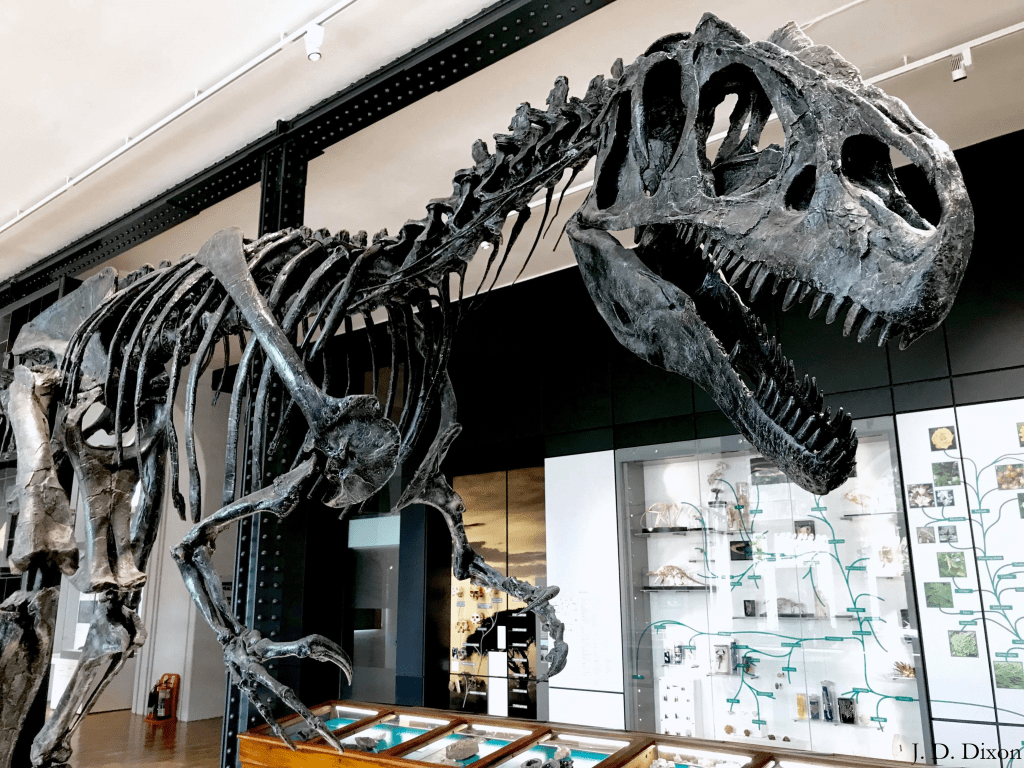
I designed this project with Dr Stephan Lautenschlager, a leading expert at the intersection of palaeobiology and biomechanics, illustrating my competence at writing proposals and collaborative delineation. I examined how different methods of bite force estimation can yield various results for the same animal. I used advanced digital methods to create virtual skull and jaw models and estimate gnathostome bite forces across three extant (Alligator mississippiensis, Buteo buteo, and Monodelphis domestica) and four extinct (Tyrannosaurus rex, Allosaurus jimmadseni, Erlikosaurus andrewsi, and Thrinaxodon liorhinus) species. The method that yielded data closer to in vivo values recorded from the extant species was deemed most accurate for use in the extinct species, and these values were deemed most appropriate.
Conserving the Horrid Ground-Weaver (Nothophantes horridus), an Endemic UK Arachnid | Conservation Report | 87%
I proposed a unique conservation strategy for Nothophantes horridus grounded in scientific importance and governmental policy.
The Ammonite Pavement | Field and Museum Skills | 87%
I developed a highly engaging, professionally designed video to illustrate the scientific background and significance of the Ammonite Pavement in Lyme Regis. This was aimed at a broad audience and was praised for its humour, bespoke animations, and excellent presentation skills.
The Fossil Trade: Fortunes and Fraud | Field and Museum Skills | 70%
I designed a museum exhibition to explore the illicit trade of fossils internationally, from illegal excavations to unauthorised auctions. It would illuminate the sordid underworld of palaeontology and let visitors learn that science suffers from criminal intrusion more than they expected. The plan illustrated the historic and contemporary ethical issues that are seldom discussed outside of academic circles in a clear and accessible manner. The proposal was applauded for its detail, coherency, and consistency, as well as the specific accommodations made for visually impaired and disabled visitors, and non-English speakers.
Assessing Site Sustainability at the Wren’s Nest: Fossil Collection and Natural Processes | Project Planning | 93%
I designed this project with a dedicated team consisting of Dr Jason Hilton, Graham Worton, Ian Beech, and Jonathan Larwood, partnering Dudley Metropolitan Borough Council and the University of Birmingham. This again illustrates my competence at writing proposals and collaborative delineation. We planned a new geo-conservation methodology at the Wren’s Nest, Dudley, part of the UNESCO Black Country Global Geopark.
A Diversity Analysis of Herbivorous Dinosaurs: The Ornithischian Array of the Triassic and Jurassic | Research Skills Project | 82%
For this project, a group of undergraduate students utilised the Palaeobiology Database to examine patterns of species diversity across different dinosaur groups. I analysed the ornithischian trends and potential drivers throughout the early Mesozoic. For this, I synthesised complex data to illustrate biological patterns in deep time while accounting for biases and discerned real trends from artefacts through intense scrutinisation. This provided an introduction to digital palaeontology and training in non-traditional methods of research at an early stage in my career.
 J. D. Dixon